Proprioception is dropping your feet on the floor when you get out of bed in the morning without having to look down; keeping your eyes on your laptop at work while you reach for your coffee without spilling it; switching your foot seamlessly from the gas pedal to the brake in the car without bending over to look at the floorboard. You don’t need to think about it, and you don’t need to see your arms, legs, or feet for any of it to occur without incident— it happens automatically, outside of your conscious thought. And though proprioception occurs on a subconscious level, there are things you can do consciously to assess your proprioceptive sense and identify ways to improve it.
Proprioception can be diminished for a number of different reasons, from aging to chronic pain to poor postural habits, leaving you at greater risk of falls or injury. The good news is that there are simple, practical things you can do to develop and strengthen it, enabling you to move and feel better in your own body. But first, what is proprioception?
Some think of proprioception as a 6th sense. Might be… but it is a part of our neural hierarchy – the other two being the visual (eyes) and vestibular (balance) systems. Those three sensory systems give the various parts of your brain information, and it interprets it so everything can work together. In that way your brain is like the ultimate virtual reality machine.
Proprioception and Daily Activities
Proprioception is part of every move we make, every minute of every day, and no anatomical part may be a better example of this than the ankle. The retinaculum of the ankle— or the fascial band around your ankle— has five times as many proprioceptive nerve endings as anywhere else in your body.
If you have a lot of proprioceptors down there, then you have a lot of voices shouting back up at your brain, ‘Hey, you’re about to twist your ankle. Right yourself, and fix it before anything happens.’ Your brain thinks ‘Oh my gosh, I’m about to sprain my ankle,’ and fixes it. If you have poor proprioception, then you don’t have a lot of guys down there ready and willing to work, so the message gets to your brain too late and you twist your ankle. It’s the difference between having a 5G network and the Pony Express.”
If you’re a very good piano player, the representation of your hands in the brain map is going to be much bigger than it would be for me, because I don’t play a single instrument. If we think of it from a motor control perspective, when we stop moving things, we lose real estate in the brain. The map in our brain that helps us with the dexterity and movement of that part will shrink. Conversely, if we use something a lot, it gets more real estate in the brain.
How Does Proprioception Work?
So now we know what proprioception does, but how does it work? You have these nerve endings called mechanoreceptors that are peppered throughout your fascial tissues at different depths and they transmit information very quickly (270mph) to your brain about where your parts are in relationship to each other.
Some of the mechanoreceptors respond to fast, sudden movements and vibration, and some respond to long, slow traction or stretching. Others have a wide range of sensations from itching, to burning, to stinging, to the stroke of a paintbrush or feather, so they are sensations that are physical feelings. They’re not touch, per se, but they’re things we feel physically, and it’s all in the domain of the fascia and connective tissue. It’s a feedback loop that gives us a real-time assessment of how our limbs are working or not working.
Proprioception and Pain
Another practical reason to understand the concept of proprioception is its connection to pain. An increase in one inevitably leads to a decrease in the other. Increase of pain is going to result in a loss of proprioception, PERIOD. Even if you don’t think you’re losing coordination, as your pain levels increase, your proprioception decreases. That’s just the way they work.
We know that immediately upon pain, the chemistry in your brain changes, and over time, that results in less representation of that body part in the brain. So that means if you have pain at a joint, either from a sprain or surgery, you’re going to have less proprioception at that body part.
A natural consequence of having a good proprioceptive sense is that you are better able to avoid situations that lead to pain or injury.
Tips To Improve Proprioception
• Move. Hike, walk, run, dance, do pilates, TRX or any other physical activity that you enjoy.
• Slow down. If you are trying to correct a movement pattern that has been altered due to injury or surgery, slow it down and take time to really perceive the information coming into your central nervous system.
• Do movement work in front of a mirror. This will give you additional visual input to help with error correction. Seeing yourself out of balance helps you make the right positional change and strengthens the brain/body connection.
• Do weight bearing exercises.
• Try fascial bouncing. Jump up and down 50 times (or stomp your feet if you have arthritis or other pain) to wake up your entire connective tissue system.
• Touch. Bring awareness to any part of your body by touching it with your hands, therapy balls, soft foam rollers, or other props. Dry brushing your skin and tapping also heighten sensory inputs.
• Walk barefoot on uneven surfaces. The beach, small pebbles, grass to give your feet opportunities to walk on something other than concrete in stiff shoes.
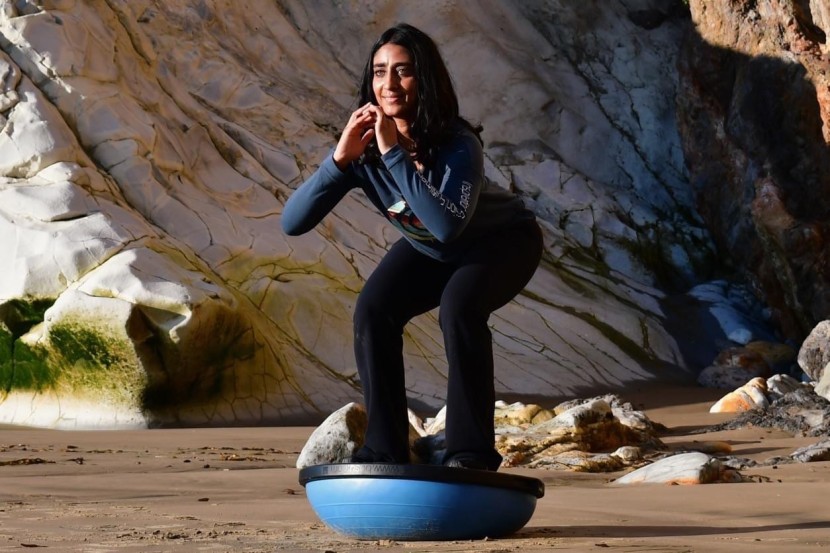
• Challenge your balance.
• Breathe. Use your breath to heighten awareness of your ribcage, noticing the expansion through your belly and the rest of your body.